Home / Topics / Software Engineering & Languages
Functional programming: videos Hacker News recommends
Functional programming: Haskell, OCaml, Clojure, Erlang, Elixir, Scala, Lisp, Scheme, immutability, monads, purity, pattern matching, Rich Hickey, Simon Peyton Jones. Below: every video in this topic that at least three HN users linked with real commentary, in at least three different months (176 talks, 14 demos, 12 lectures), best-scored first, with the comments on each video page.
- Programming language design 193
- C, C++, Rust, Go & systems languages 163
- Python, Ruby & scripting languages 120
- Web development 160
- Software architecture & design 177
- Software performance & optimization 123
- Compilers, interpreters & program analysis 98
- Testing, debugging & developer tools 155
- Software practice, open source & careers 154
- Software (other) 36
- HN recommends it repeatedly as one of the best and most entertaining programming talks, and as the talk that makes the Y combinator click, even for people who do not use Ruby.
- It is HN's favorite pitch for Elixir and the BEAM, credited with convincing many people to adopt them.
- HN treats it as the canonical talk on software complexity, shared constantly and recommended to every programmer regardless of language.
- HN repeatedly recommends it as a talk that changed how people model data, with ideas that apply well beyond Elm to any typed language.
- HN repeatedly recommends it as an amazing talk that derives the essence of Lisp and shows miniKanren-style program synthesis.
- HN commenters cite it as the talk that convinced them of immutability and functional programming.
- Metosin talk recommended in 12 different months by 12 HN users, 2019–2025HN treats it as the standard answer to why FP isn't mainstream and why languages succeed.
- HN commenters send people to it whenever nulls, Maybe/Option or static typing come up, as a thoughtful dissent from the type-system orthodoxy that changes how some people model data.
- Clojure/north talk recommended in 11 different months by 10 HN users, 2019–2025HN repeatedly recommends it as a fantastic demonstration of procedural, OOP and FP approaches to the same problem, and of functional core and imperative shell.
- HN people recommend the SICP lectures as a deeper, livelier route into the book and a formative course even for seasoned programmers.
- Recommended whenever APL or array languages come up as the quickest way to see why the paradigm is so striking.
- Seen as a classic and often the moment programming 'clicks'; commenters praise Abelson's opening that computer science is not about computers.
- HN's go-to link in typing debates and for talk lists, and several call it their favorite programming talk even for non-Clojure users.
- The go-to talk showing how Erlang let a tiny team run a massive messaging system.
- HN returns to it constantly as permission and method for thinking deeply before coding, and as an antidote to always-working anxiety.
- HN repeatedly names it among the best programming talks, loved for its craftsmanship message that complex tooling can hide simpler solutions.
- HN repeatedly recommends it as the clearest and most correct beginner explanation of monads, with several commenters saying it finally made them click.
- HN recommends it as the canonical presentation of 'functional core, imperative shell' and a practical answer to unit versus integration testing.
- HN repeatedly cites it as a striking example of Common Lisp used to push the frontier of science, and as one of the most inspiring tech talks.
- It is one of HN's most frequently recommended programming talks, cited whenever people debate complexity, simplicity and abstraction, and valued well beyond Clojure.
- HN returns to it in every versioning and API stability debate as a challenging, contrarian talk worth watching.
- Bartosz Milewski lecture recommended in 9 different months by 11 HN users, 2016–2026HN commenters repeatedly name it as the friendliest entry point to category theory for working programmers.
- HN recommends it as a key Hickey talk on system design that changes how people think about distributed state and interfaces.
- HN commenters recommend it whenever someone asks how to read type-system or CS notation in papers.
- HN repeatedly recommends it as the talk that made data-oriented, REPL-driven bottom-up design click.
- European Lisp Symposium talk recommended in 8 different months by 4 HN users, 2016–2022HN commenters recommend it as a brilliant talk on Julia's design and how it is or isn't a Lisp.
- HN returns to it constantly as a witty, still-accurate diagnosis of why software is bloated and messy, and as a go-to recommendation in any thread on modules, package managers or software quality.
- It is the favorite recommendation for understanding Moore's minimalist, low-power multi-core designs and stack machines.
- HN returns to it constantly as the talk on live programming and what modern tooling is missing, though a few found it too much.
- HN treats it as the best introduction to Unison, with commenters finding hash-addressed immutable code mind-blowing.
- A repeatedly recommended introduction to functional JavaScript that explains currying and why data should come last.
- HN recommends it as an alternative or companion to 'Simple Made Easy', and quotes its ideas about simplicity, complexity and 'hairballs' in discussions of frameworks, JSON and data design.
- HN repeatedly recommends it as a delightful talk that makes music theory click and introduces Clojure and Overtone.
- HN people recommend it as an eye-opening talk whose domain-modeling ideas carry over to other languages and make a strong compiler feel like a coding partner.
- HN recommends it as the primary source for understanding LiveView's advantages and its middle ground between multipage apps and SPAs.
- Repeatedly offered as the quickest, most convincing demo of structured editing and why Lisp programmers love paredit.
- HN loves it as a funny, shorter sequel and even uses it to introduce Erlang in university classes.
- HN people point to it for rrb-trees, text editor data structures and bringing Clojure-style persistent structures to C++.
- It is the go-to answer to whether Prolog is used for real-world work, praised as a survey of its uses, advantages and drawbacks.
- Recommended as a practical demonstration of how functional thinking improves design without going off the deep end.
- HN uses it in debates about what OOP originally meant, since Kay's message-passing view lines up with Erlang's processes.
- Fullstack Academy lecture recommended in 5 different months by 5 HN users, 2019–2024Repeatedly recommended as one of the most approachable introductions to lambda calculus and combinators.
- HN treats it as the original and definitive explanation of transducers, recommended whenever the concept comes up.
- HN recommends it as the best video introduction to the actor model, straight from its inventor, and revisited it after Hewitt's death.
- Bruce Hauman demo recommended in 6 different months by 6 HN users, 2015–2020It is the canonical demo HN people cite for live interactive development and hot reloading, as proof the workflow is real and not smoke and mirrors.
- Chris McCord tutorial recommended in 6 different months by 7 HN users, 2020–2025HN points people to it as the demo that shows why LiveView and Elixir are worth a look.
- Fred Overflow talk recommended in 5 different months by 5 HN users, 2020–2026Cited as the classic rant on maps versus objects in discussions of data modeling and OOP.
- Recommended as the clearest explanation of Elm's design thinking and of making functional languages mainstream, plus a popular monad explanation clip.
- HN people point to it as the clearest explanation of what FRP actually means and how its flavors differ.
- Strongly recommended as a beautiful demonstration that APL can be read and reasoned about step by step.
- HN commenters recommend it, alongside Rich Hickey's talk, for its precise definition of simple versus easy and its implications for code design.
- Seen as the definitive explanation of why traditional concurrency is hard and how Clojure's model addresses it, with some commenters crediting it with changing their careers.
- HN recommends it as the best introduction to Factor and concatenative programming, with commenters saying it impressed them with the engineering.
- It is the standard recommended introduction to Shen, pointed to whenever Shen or its type system comes up.
- Recommended for its practical strategy for preserving state on ephemeral containers, and for the live demo.
- Groxio talk recommended in 5 different months by 4 HN users, 2023–2025HN recommends it as a rare real-world look at a large fault-tolerant Erlang/Elixir system with no downtime in healthcare.
- Recommended as the clearest explanation of why immutable data need not be slow, and as the introduction to Roc.
- HN commenters point to it whenever Excel, spreadsheets or functional programming come up, as a fun and serious take on spreadsheets as real programming.
- HN recommends it as a fascinating explanation of queues, flow control and overload that applies well beyond Clojure.
- Scala World talk recommended in 5 different months by 5 HN users, 2016–2025HN recommends it as a talk that changes how you think about system design, and links it whenever constraints, abstraction or least power come up.
- Zhang Jian talk recommended in 5 different months by 4 HN users, 2021–2026Recommended as one of the best explanations of why Clojure and a functional, immutable approach to state exist.
- Strongly recommended in lambda calculus and Y-combinator threads as a mind-expanding half hour that clarifies the ideas.
- HN points to it as the original talk that explains the motivation behind React, Flux and Redux, and that sold some commenters on React.
- Kalman Reti demo recommended in 5 different months by 5 HN users, 2014–2024The go-to demo whenever HN discusses what Lisp machines were like and what modern shells and editors lack.
- PyCon 2019 tutorial recommended in 4 different months by 4 HN users, 2019–2021HN calls it a brilliant, mind-bending introduction to lambda calculus for programmers.
- Churchill College, University of Cambridge lecture recommended in 5 different months by 5 HN users, 2017–2024Recommended as a funny, accessible history of Haskell that is valuable even for people interested in language design in general.
- Recommended as a fantastic talk on code-driven CAD and custom keyboard design, linked in threads on OpenSCAD and keyboards.
- Kostiantyn Kostin talk recommended in 5 different months by 5 HN users, 2013–2025Cited again and again as Carmack's key public statement on functional programming and purity in game development, plus his remarks on garbage collection.
- Recommended as the approachable way into a precise definition of language expressiveness for language-design arguments.
- HN commenters recommend it as a mind-expanding talk on rethinking programming, and cite it in threads on propagators, constraints and brittleness.
- HN points to it as a clear explanation of immutable data structures such as tries, and of the case for immutability with React and Flux.
- Reaktor talk recommended in 4 different months by 4 HN users, 2018–2021HN commenters love it as a witty and insightful tour of design anti-patterns, applicable to DSLs, OOP and API design.
- nuACM talk recommended in 5 different months by 5 HN users, 2010–2017Recommended as a fascinating look at easy parallelism abstractions, though other commenters note the approach never beat sequential C by much.
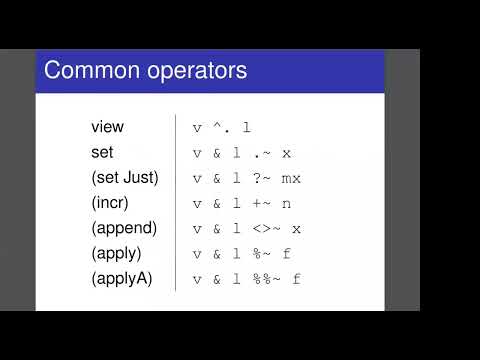
- Bay Area Haskell talk recommended in 4 different months by 4 HN users, 2020–2024HN recommends it as the fastest way to learn lenses by example, with far-out examples later on.
- Matt Marenghi talk recommended in 4 different months by 5 HN users, 2014–2016Recommended as a clear, mind-changing introduction to observables and async programming from engineers using Rx in production.
- Recommended as the argument for code colocation and delaying abstraction.
- KanDDDinsky talk recommended in 4 different months by 3 HN users, 2020–2026HN treats it as the canonical, approachable example of domain-driven design with types and 'make invalid states unrepresentable'.
- ReasonConf talk recommended in 4 different months by 4 HN users, 2019–2022HN recommends it as the best introduction to Reason's motivations, straight from React's creator.
- HN points people to it as the clearest account of why Datomic is designed the way it is and of the problems with conventional database architecture.
- Recommended as the best demo of interactive, compiler-assisted dependently typed programming in action.
- HN commenters call it a beautiful, brilliant demonstration of APL's expressiveness and a model of clear narration.
- HN recommends it as a talk that changed how people debug, worth rewatching periodically.
- HN recommends it as the best beginner-friendly introduction to monoids, monads and other FP vocabulary.
- HN recommends it as the original LiveView announcement and demo, a compelling argument for server-side rendering as an alternative to JavaScript front ends.
- Wolfram demo recommended in 4 different months by 4 HN users, 2014–2015Commenters point to it as a compact, impressive demo of what the language can do.
- HN points to it as a clear lesson that algebraic properties like associativity unlock parallelism, applicable in any language.
- Red Martian demo recommended in 4 different months by 4 HN users, 2014–2026HN cites it as a startling example of how advanced Lisp machine interactive graphics were, often in Lisp and REPL-driven development discussions.
- Cited as the more accessible companion to the paper, and as the most interesting treatment of AD via compiling to categories.
- uncertainyesterday demo recommended in 4 different months by 4 HN users, 2013–2026A beloved classic that HN recommends as the quickest way to see why Erlang is special.
- Recommended as the best introduction to property-based testing and cited for its examples of bugs found in the CAN standard.
- HN people recommend it as a reading list of historical CS ideas worth knowing, and as a favorite among Armstrong's talks, especially after his death.
- Ron Pressler - Pull Push: Please stop polluting our imperative languages with pure concepts-Curry OnRecommended as the case for blocking code and virtual threads over monads and async/await.
- HN recommends it in literate programming threads as a rare look at applying the idea to a huge, complex codebase, though some find it meandering.
- HN commenters recommend it as the lead ClojureScript developer's own account of Om's evolution, one-way data flow and single-state design.
- Recommended in incremental computation and reactive UI threads as the best conceptual overview of Incremental and incr_dom.
- HN remembers it as the memorable explanation of restarts and multiple dispatch, referenced whenever those features come up.
- Konfy talk recommended in 4 different months by 2 HN users, 2020–2023Commenters point to it as a clear take on why functional languages stall outside niches, and its lessons are seen as applying to any technology trying to go mainstream.
- HN points to it as a good introduction to Idris 2 and a striking demonstration of what dependent types enable.
- HN commenters call it a fantastic introduction to Clojure and the thinking behind its design.
- HN recommends it for getting the inventors of major concurrency models together, disagreements included.









Showing the 100 best-scored of 225. Use search to find the rest.
Questions
What is the most recommended functional programming video on Hacker News?
Ruby Conf 12 - Y Not- Adventures in Functional Programming by Jim Weirich by Confreaks: HN recommends it repeatedly as one of the best and most entertaining programming talks, and as the talk that makes the Y combinator click, even for people who do not use Ruby.
How is this functional programming list ranked?
By HackerTube's score: the number of distinct months in which an HN comment recommended the video, plus half a point for every month with a strong recommendation. One viral thread counts less than steady recommendations over years.
Where do the videos come from?
From every Hacker News comment between 2007 and 2026 that linked a YouTube video, labeled by an AI model as a recommendation, a citation, a joke or a criticism. The list is published by HackerTube under ODC-By 1.0; this edition adds indexable pages and the comment context.