1 HN user recommended this demo1 month2011–2017score 1
Years with an HN recommendation, 2007–2026
Cited as a landmark demonstration of how capable autonomous drones had become, mostly in threads about drone delivery, swarms and drone warfare.
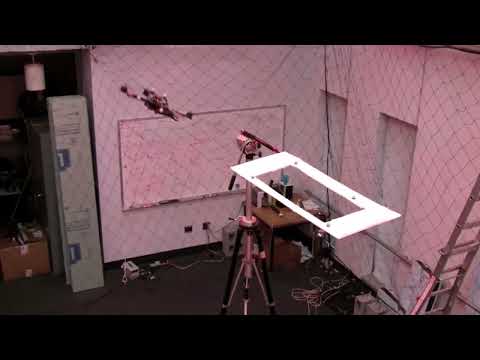
A demonstration from UPenn's GRASP Lab of an autonomous quadrotor performing flips, flying through windows and perching on surfaces. It shows precise aggressive maneuvering control of a small UAV.
“The real takeaway is the radical increase in the abilities of flying drones” (HN, 2011)
The simple matter is that the implications of these drones reaches far beyond simply building things, like showing one aspect of what a hammer can be used to build. The real takeaway is the radical increase in the abilities of flying drones, and the raw potential they leave to be harnessed by future engineers and entrepreneurs. Those who discount their usefulness by staying within the context of the video, and not elaborating outside of that, aren't getting it. I would refer you especially to @burgerbrain's comment and the videos he posted. Specifically: [this video]
This lab has several other videos with quad rotor robots like this (e.g. [this video] ), but don't worry about them escaping and starting a robot domination: they rely on infrared motion capture systems in that room for extremely precise location sensing. Once GPS gets sub-meter accuracy, then we should start worrying.
Did you watch the same videos I did? They have these things lifting sizeable pieces of 2x4's ( [link] ) and they pull of some pretty absurd manoeuvring ( [this video] ) and recovery ( [link] ). Navigational issues resolved, I have a hard time seeing these things having trouble with a modest wind.
I'm completely with you, and it could be a great way to get the public interested in (i.e. funding) technology. It reminds me of when auto racing actually led to improvements for street cars. I mean kids already love various robotic cartoons - who wouldn't love the same as a real-life game. Attendance could be a little dangerous though... Let's hope UPenn's QuadRotor Lab is in the running. [this video]
UPenn quadrotor lab as a candidate for drone sport
People like the GRASP[1] guys: [this video] are probably somewhere pretty high on that list. They still need to solve the location sensing issues though - having high-precision calibrated wall mounted sensors aren't really practical for ad-hoc use. I don't doubt that someone will solve this problem in the not-too-distant future though, and heavily autonomous quadrotor aerostats will be in heavy use. [1] [link]
I think you're referring to the grasp lab at UPenn, they did stuff with quad rotors landing on Velcro. [this video] Georgia Tech did more with the larger Yamaha Rmax helicopter. [link]
Projects using quadrotors to do things like fly cooperatively and do acrobatics [1,2] will often use high speed motion capture systems with multiple fixed cameras. This decouples the problem of perceiving the environment from the problem of responding to the environment. More broadly in robotics there are plenty of people working on ground-based robots that don't rely on multiple fixed high speed cameras - self-driving cars [3] would be one example. There are also people working on cooperative ground based robots that don't rely on multiple fixed high speed cameras - for example, the RoboCupSoccer Middle-Size League [4]. There are also people working on quadrotors that don't cooperate/do acrobatics and who don't rely on fixed vision systems - for example people working on autonomous quadrotor mapping [5] and using IMUs and on-robot vision [6]. [1] [this video] [2] [link] [3] [link] [4] [link] [5] [link] [6] [link]
Example of acrobatic quadrotors relying on motion capture
I believe this is possible. Just look at these autonomous drones doing stunts: [this video] Delivering a packet is much easier than the stuff the are doing in this vid.
Autonomous drone stunts as evidence delivery is feasible
Can't. I met the guy in person while travelling by train. He had the drone in question in his suitcase. He did tell me however he was involved with this [this video] (Or another such effort —I met him in France.)
I wonder how well the learned policy generalizes to other environments. Places like an art gallery, outside, or a cave. Could the network have learned something fundamental about monocular vision? It would also be interesting to see if the learned policy corrects for perturbations. If we tilt the drone by hitting it, will the policy stabilize it again? While this is a really cool result, I suspect that this approach might not be the best way to control UAVs. Dragon flies are ready to fly, avoid obstacles, perch on stuff, hunt down prey right after warming up their wings for the first time. This implies that a good amount of the flight behavior is 'hard-coded.' Although I really can't wait until someone expands upon this approach. So instead of outputting left or right, the network could output 'stick vectors,' which translate to control stick commands. Maybe even have the network take in some sensor data and a 'move in this direction' vector. Add in a pinch of sufficiently fast video processing and we could probably learn how to do fly through an FPV course or do aggressive maneuvers to fly through someone's windows[0] [0] [this video]
Video list and Hacker News comment labels from HackerTube (prompted by @karpathy), released under ODC-By 1.0, built on the open-index/hacker-news archive. Hacker News data is provided by Y Combinator; comments remain the work of their authors. Video titles, channel names and thumbnails belong to their creators and are shown via YouTube. HackerTube Watch is an unofficial edition. Data export of 2026-10-31.
 Plays via YouTube's privacy-enhanced embed
10 Hacker News comments
From the HN archive; up to 20 kept per video, favoring different commenters. Recommendations first.
Citations, criticism and jokes
Read more
Read more