17 HN users recommended this explainer15 months2013–2024score 18.5
Years with an HN recommendation, 2007–2026
Held up as a marvel of pedagogy and the best explanation of differentials, recommended again and again.
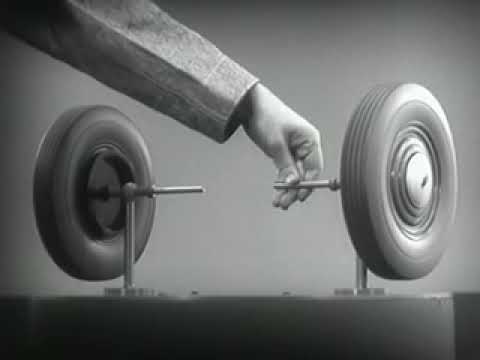
A 1937 GM-produced film explaining how the automobile differential lets wheels turn at different speeds around a corner. It uses clear animations and cutaway demonstrations to build the idea from first principles.
“this video explaining differentials is from 1937 and is a marvel of pedagogy” (HN, 2019)
That was a great video, thank you! Knowing basic gear mechanics helps a lot in understanding how cars function. This 1937 video about differentials is also enlightening: [this video] Why is it that old tutorial videos are so thorough and informative?
Thorough 1937 explanation of how differentials work.
One of the best "how this mechanical thing works" for me is about differential/steering by Chevrolet (1937.). It's almost 100 years old by now but still one of the best "how" videos ever. [this video]
Not just military training videos, older ones in general are often superior to what gets made today. My favorite is probably this one on vehicle differentials: [this video]
This is great. As for the criticism that a lot of the content is old, most of the core concepts can be explained better with older tech as it's simpler. This allows you to focus on what is happening and leave the extra details about what technology a part or process has for a case by case basis. [this video] is a great example of this. Saying that, an article on direct injection, common rail diesels, efficient turbo charging, variable valve timing, MAF VS MAP EFI would be worth considering.
Example of explaining core concepts with simpler older technology.
Here are the key takeaways for me: "Thanks to that differential between your axles, an AWD car will send your engine’s power down the path of least resistance—the wheel with the least grip. Where a two-wheel drive car can only choose between two wheels, an AWD system looks for that least resistance across all four wheels." "4WD works by locking the front and rear axles together, splitting torque 50:50 between them. This provides great traction, but a vehicle locked in 4WD cannot safely be operated on dry pavement because its front and rear axles are forced to rotate at the same speeds." I remember being scared when I bought my first 4wd vehicle, a '91 Toyota pickup. I knew I shouldn't have the wheels locked in 4wd on dry pavement, and I was worried about going from snowy roads to dry pavement. When I moved on to an Outback (AWD, not 4wd) I wondered why I didn't have to worry about transitioning between slippery roads and dry pavement. Now I understand. There's also a great video from 1937(!) that shows why we need differentials, and how they work. Here's a direct link to the video if you're going to skip the article: [this video]
Shows why differentials are needed and how they work.
Videos were very instructive back then too. At some point, we started to prioritize form over function. E.g. [this video] [Around The Corner - How Differential Steering Works (1937)]
Example of instructive old videos that prioritized function over form.
A few months ago, this video [0] from the 30ies explaining a differential was posted on HN. It also is extremely interesting to watch. Minute 5 is very illuminating. [0] [this video]
Extremely interesting 1930s differential explainer with a key insight at minute 5.
How guns work: [link] How a car differential works: [this video] Downright the best zero-to-programmer course in the world. Wish I knew about it when I was starting out: [link]
Listed as a favorite tutorial for total beginners.
I would maybe start with the individual components. How a differential works: [this video] There are a number of videos of transparent engines: [link] But if that doesn’t work, searching YouTube for “how an engine works” should give lots of content. Once you’ve figured out how the engine turns the flywheel, you can investigate how the flywheel applies different speeds to the wheels via a transmission. Manual transmissions are simpler, so I would start there: [link] then figure out how the clutch fits in. After that, you can move on to torque converters (coolest component imo, basically a fluid coupling) and automatic transmissions, which can be a mind-bender. Feel free to reach out to me at pc.peterso at Mail of g dot common TLD, happy to share what I learned and save you some time. Lastly, there is a wealth of tidbits on Engineering Explained and howacarworks.com, although the latter goes into far more detail than you probably need.
Starting point for learning how car components work.
Similar videos about cars: Chevrolet Suspension (1938): [link] How Differential Steering Works (1937): [this video] How A Transmission Works (1936): [link] And as a bonus, an explanation about transistors from 1953: [link]
I find this to be true. It seems like there was more focus on the very, very basics. Now there is a ton of filler and the content gets lost. E.g.: [this video]
Offered as an example of focus on basics without filler.
Video list and Hacker News comment labels from HackerTube (prompted by @karpathy), released under ODC-By 1.0, built on the open-index/hacker-news archive. Hacker News data is provided by Y Combinator; comments remain the work of their authors. Video titles, channel names and thumbnails belong to their creators and are shown via YouTube. HackerTube Watch is an unofficial edition. Data export of 2026-10-31.
 Plays via YouTube's privacy-enhanced embed
20 Hacker News comments
From the HN archive; up to 20 kept per video, favoring different commenters. Recommendations first.
Read more
Read more
Citations, criticism and jokes